Actualisé 7 Heures il y a
Espace vide dans un emballage de café: Quel article 24 Nécessite de 2028, et pourquoi l’espace de tête et les gaz protecteurs ne comptent pas

ypak.coffee
YPAK PACKAGING GROUP a été créé à 2011 et formé avec 3 entreprises basées à Hong Kong, Dongguan et Foshan. Nous sommes devenus l’un des plus grands fabricants de sachets de café en Chine. Nous utilisons les meilleures vannes WIPF de Suisse pour garder votre café frais.
Respecter la politique d’interdiction du plastique imposée à de nombreux pays différents, Nous avons recherché et développé les sacs d’emballage durables, comme les sachets RECYCLABLES et COMPOSTABLES.
Pas de quantité minimale, aucune plaque couleur n’est requise avec notre service d’impression numérique HP 25K INDIGO.
Vous êtes les bienvenus pour visiter YPAK.
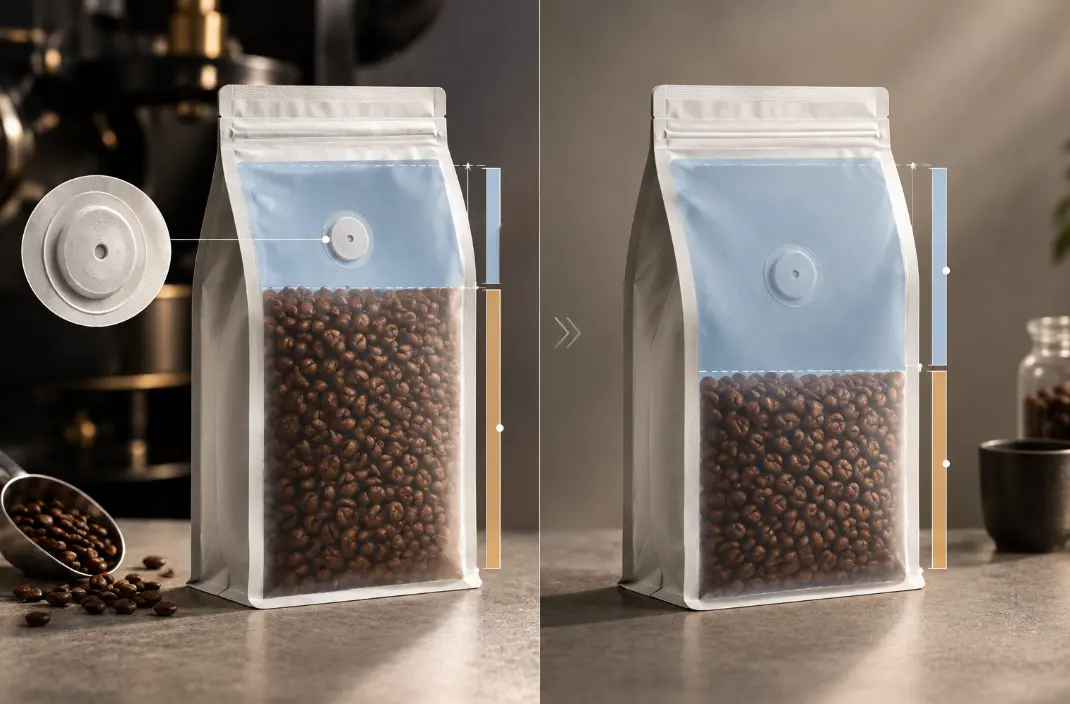
Le règlement européen sur les emballages et les déchets d’emballage (PPWR, Réglementation (EU) 2025/40) has applied since 12 Août 2026. The empty space rules, toutefois, run on a different clock and a different logic: two categories of packaging, two sets of rules, and one provision that changes the answer for roasted coffee. This article sets out what Article 24 actually says, why coffee can follow a different compliance path, and how that argument becomes evidence you can place in the technical documentation.
Sachets de café: two sets of rules, not one — start by classifying your packaging
Before any percentage is discussed, one more basic question has to be answered: in the wording of the regulation, which category does your packaging fall into? The category decides which article applies, which date applies, and what the compliance test actually measures.
A retail coffee bag sold directly to consumers is sales packaging. Put six of those bags into a corrugated carton and ship it to a distributor or a café, and the carton is transport or grouped packaging; if that same carton is sent to a consumer after an online order, it may also be e-commerce packaging. One shipment, three categories, three sets of rules.
There is also a pair of obligations that is frequently conflated. The PPWR deals with two different things in two different articles:
- Article 24, "Obligation related to excessive packaging" — deals with empty space, and sets out separate rules for sales packaging on the one hand and grouped, transport and e-commerce packaging on the other.
- Article 10, "Packaging minimisation" — deals with the weight and volume of the packaging itself, requires that these be reduced to the minimum necessary for functionality, and specifies how that must be demonstrated in the technical documentation.
The two obligations run in parallel, each with its own dates and its own evidence requirements. Treating them as one is the most common error in current industry material, and it is the first thing this article clarifies.

Sachets à café à fond plat: why the category comes before the number
A concrete example. UN 1 kg flat bottom coffee pouch sold directly to a consumer is subject to the sales packaging rule: the regulation sets no percentage ceiling for it, and requires only that empty space be reduced to the minimum necessary to ensure the packaging function, including product protection (Article 24(4)). Place that same pouch into a six-pack display carton used for transport and collation, and the carton is subject to a different rule: a maximum empty space ratio of 50% (Article 24(1)).
The same word — packaging — one requirement of "minimum necessary", the other of "no more than half". That is why classification comes first and the number comes second.
Flat bottom pouches and shipping cartons: who the 50% figure applies to, and when
Article 24(1) provides that by 1 Janvier 2030, or three years from the entry into force of the implementing acts adopted under Article 24(2), whichever is the latest, economic operators who fill grouped packaging, transport packaging or e-commerce packaging must ensure that the maximum empty space ratio, expressed as a percentage, est 50%.
Three elements in that sentence have to be stated together. Leaving any one out produces an inaccurate claim:
- Scope: grouped packaging, transport packaging and e-commerce packaging — not sales packaging.
- Threshold: a maximum empty space ratio of 50%.
- Timing: 1 Janvier 2030, or three years after the entry into force of the calculation methodology implementing acts — whichever is the later. If those implementing acts arrive late, le 50% obligation shifts accordingly.
Article 24(5) adds a further point: economic operators who use sales packaging as e-commerce packaging, or who use reusable packaging within a system of re-use, are exempt from the obligation in Article 24(1). Their sales packaging must nevertheless comply with Article 10. What is exempted is the 50%, not the whole set of obligations.
The table below sets out both rule sets side by side. It is also the reference point for every statement that follows in this article.
| Dimension | Sales packaging (Sacs de café au détail) | Grouped / transport / e-commerce packaging |
| Article | Article 24(4) | Article 24(1) |
| Threshold | No percentage in the regulation; empty space must be reduced to the minimum necessary to ensure the packaging function, including product protection | Maximum empty space ratio of 50% |
| S’applique à | 12 Février 2028 | 1 Janvier 2030, or three years from the entry into force of the Article 24(2) implementing acts, whichever is the latest |
| What is measured | Total internal volume of the sales packaging minus the volume of the packaged product; where products settle in transport or headspace is needed to protect food, compliance is assessed at the pack-fill level at the time of filling | Total volume of the packaging minus the volume of the sales packaging contained within it |
| Filling materials | Counted as empty space | Counted as empty space |
| Exception | Products that settle in transport, or that need headspace to protect the food: air between or within the packed foodstuff and protective gases are not counted as empty space (Article 24(4), third subparagraph) | Operators using sales packaging as e-commerce packaging, or reusable packaging within a re-use system, are exempt from paragraph 1 but must still comply with Article 10 (Article 24(5)) |
| Review | Article 24(6): par 12 Février 2032 the Commission will assess whether to establish empty space ratios for sales packaging | Article 24(6): the same review covers the 50% ratio and the exemptions |
Sachets à soupapes pour café: what sales packaging must do from 12 Février 2028
The first subparagraph of Article 24(4) provides that by 12 Février 2028, economic operators who fill sales packaging must ensure that empty space is reduced to the minimum necessary for ensuring the packaging functionality, including product protection. The same subparagraph defines the empty space ratio for sales packaging as the difference between the total internal volume of the sales packaging and the volume of the packaged product.
There is no percentage here. For sales packaging, the regulation works with a functional standard — the minimum necessary — rather than a numerical threshold. Any statement to the effect that sales packaging must stay below a particular empty space percentage therefore has no basis in the legal text.
For a valve coffee pouch, the practical consequence is this: you need to explain, in the design file and at the filling line, why the internal volume of the current pouch cannot be reduced further. That explanation is not a sentence of justification. It has to stand up as an argument inside the technical documentation, and the required content is set out in sections 8 et 9 ci-dessous.
One timing detail is worth separating out. 12 Février 2028 is both the date on which the sales packaging empty space obligation begins and the deadline by which the Commission must adopt the implementing acts establishing the calculation methodology (Article 24(2)). These are two different things: one is your obligation, the other is a regulator action. Keep them apart in internal communication.
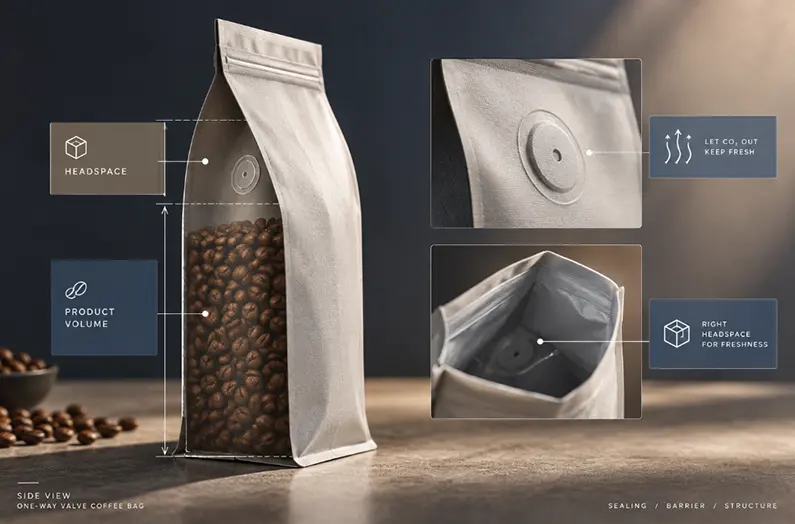
Emballage des grains de café: why coffee gets a different compliance path — degassing, headspace and protective gas
The third subparagraph of Article 24(4) sets out an exception for a defined group of products. Its substance is this: for sales packaging of products that are subject to settlement during transportation, or where headspace is required to protect the food product, or for other products presenting those characteristics: (a) compliance with the paragraph is assessed as the pack-fill level at the time of filling; et (b) air between or within the packed foodstuff, and protective gases, are not to be considered as empty space.
Pour l’industrie du café, no other provision lands as directly. Roasted coffee falls into both situations the provision describes.
Emballage des grains de café: degassing and settlement
Après la torréfaction, coffee continues to release carbon dioxide, typically for a period of days to more than two weeks. That gas has to go somewhere. If it is trapped, pressure builds up during transport and warehousing: the pouch swells, the seal comes under load, pallets become unstable, and in the worst case the pack fails.
This means the internal volume of a coffee pouch is dynamic from the moment of filling. The volume the beans occupy at filling is not the same as their settled bulk density several days later; the balance between solid and gas inside the pack keeps changing. Article 24(4) exists for precisely this kind of product, and it moves the compliance reference point from a static visible gap to the pack-fill level at filling.
Sachets à soupapes pour café: protective gas and residual oxygen
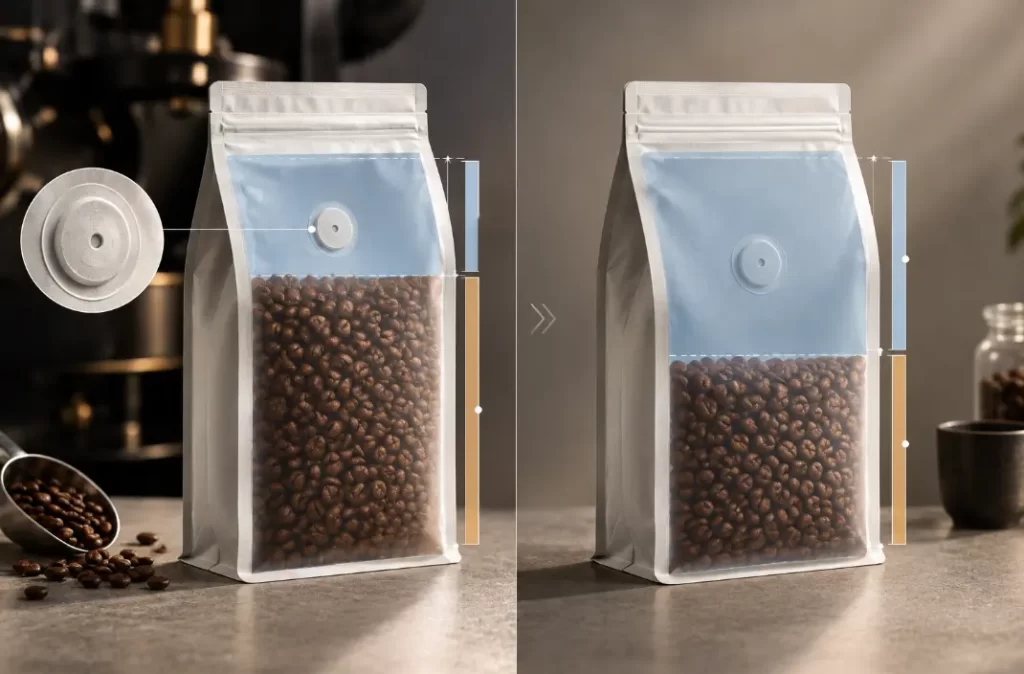
Speciality coffee is normally protected by one of two approaches: flushing with an inert gas such as nitrogen to displace oxygen, or fitting a one-way degassing valve that lets carbon dioxide out while keeping oxygen out. Both leave a proportion of non-solid space inside the pouch. That space performs a protective function; it is not there to inflate the pack visually.
Article 24(4), third subparagraph, point (b) therefore states plainly that air between or within the packed foodstuff and protective gases are not considered empty space. Pour l’emballage du café, this sentence is the most direct compliance basis available.
On the technical parameters connected to freshness, the figures we publish are stated consistently as follows. They are our measured values or internal standards, not regulatory requirements, and should be cited as such: oxygen transmission rate OTR < 5 cc/m²/day; water vapour transmission rate WVTR ≤ 0.5 g/m²/24hrs; WIPF one-way valve opening pressure tolerance ±2 mbar.
Sachets à café à fond plat: the pack-fill level at filling is the reference point
Pulling the rule together, the operational work for a coffee business comes down to three things:
- Record the pack-fill level at filling. Compliance is assessed at the pack-fill level at the time of filling, so the filling record is itself the evidence — and that record comes from the filling equipment and process, not from a note written afterwards by the design team.
- Explain the functional reason for the headspace. State clearly whether it exists for degassing and settlement, to accommodate protective gas, or to meet the closure and line-running requirements of the packing machinery — as opposed to achieving a fuller visual appearance.
- Define the measurement basis for "product volume". The sales packaging ratio is measured against the volume of the packaged product, which for coffee means the actual volume of the beans or ground coffee, measured on the same basis as the total internal volume.
All three sit on a data handover between the packaging supplier and the roaster. Brands rarely hold filling-line parameters or valve specifications themselves, which is exactly why the packaging manufacturer has to be part of the exercise.
Mono-material coffee pouches: what still counts as empty space — filling materials get no exemption
Once it is clear that coffee headspace and protective gas can be excluded, a common misunderstanding follows: if internal space can be excluded from the count, can the pack simply be filled out with void fill? It cannot.
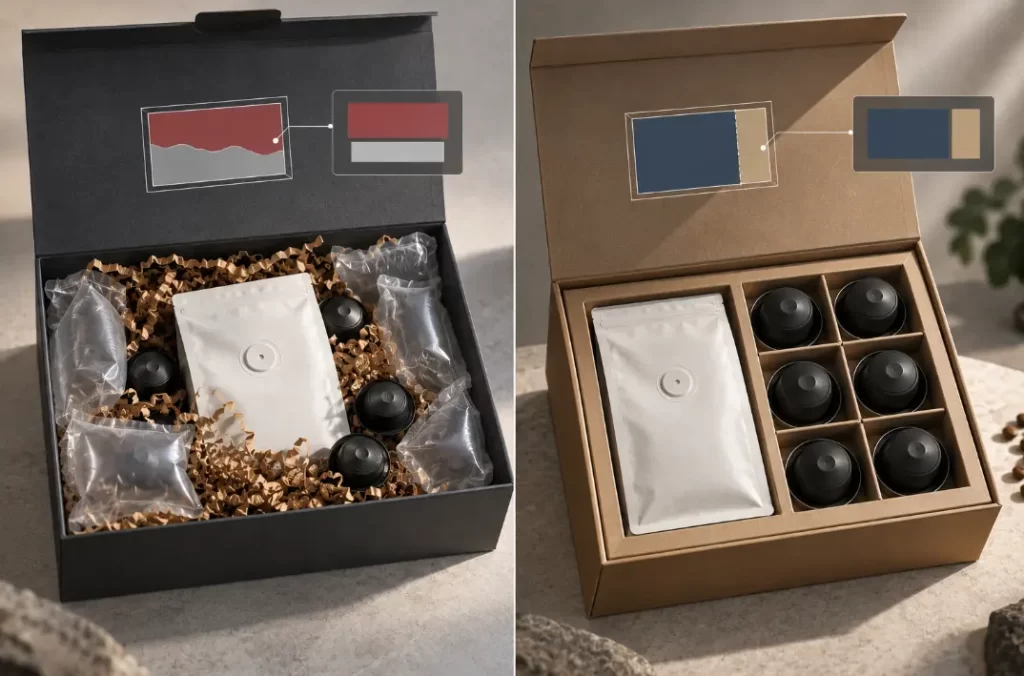
The final subparagraph of Article 24(3) provides that space filled by filling materials — such as paper cuttings, air cushions, bubble wraps, sponge fillers, foam fillers, wood wool, polystyrene or Styrofoam chips — is to be considered as empty space. The second subparagraph of Article 24(4) applies the same treatment to sales packaging.
Autrement dit: coffee headspace and protective gas are functional, and the regulation expressly excludes them; materials inserted by hand to occupy space are pure padding, and the regulation expressly counts them. The dividing line is function, not whether something visible is present inside the pack.
The practical direction for packaging design is therefore not to fill the void in a carton or gift box with inserts, pads or loose fill, but to return to the structure itself: whether layers are redundant, whether thickness tolerances can be tightened, whether the footprint taken by the valve seat and the zipper can be optimised. Those are the reduction opportunities covered in section 9.
Emballages de café recyclables: how the ratio is calculated, and why no figure can be given yet
Emballages de café recyclables: the two definitions
Article 24(3) gives two definitions, corresponding to the two rule sets:
- (a) empty space means the difference between the total volume of the grouped packaging, transport packaging or e-commerce packaging and the volume of the sales packaging contained within it;
- (b) empty space ratio means the ratio of the empty space as defined in point (a) to the total volume of the grouped packaging, transport packaging or e-commerce packaging.
For sales packaging, the measurement basis is given separately in the first subparagraph of Article 24(4): the difference between the total internal volume of the sales packaging and the volume of the packaged product. Note that the denominators differ — grouped packaging is measured against total volume, sales packaging against total internal volume. The two cannot be used interchangeably in the technical documentation.
Mono-material coffee pouches: the methodology is still open — and this is where most inaccuracies are written
Article 24(2) provides that by 12 Février 2028 the Commission must adopt implementing acts establishing the methodology for calculating the empty space ratio referred to in Article 24(1). That methodology has to take account of a number of special characteristics, listed in the text: products of irregular shape; packaging containing more than one sales packaging or product; packaging containing liquid products; packaged products whose contents can easily be damaged; packaged products that can be damaged by larger products because of their small dimensions; and the minimum space on transport packaging needed to affix shipment labels. The implementing acts are adopted under the examination procedure in Article 65(2).
What this means is that, as at the date of writing, the official methodology — how volume is determined, how special cases are treated, what allowances apply — has not been established. Three consequences follow:
- Any statement that the calculation methodology is settled, or that offers conversion factors as official, is inaccurate.
- Until the implementing acts are published, a business may build an internal calculation model following common industry practice, but it must be labelled as an internal method and not presented as a regulatory requirement.
- For now, the minimisation argument in the technical documentation should rest on qualitative reasoning supported by measured data, with a clearly marked route to recalculate once the official methodology is available.
Coffee boxes: the parallel obligation under Article 10
Empty space is about how much room is left inside. Packaging minimisation is about whether the packaging itself can be lighter and smaller. The two are handled by different articles. The core provisions of Article 10, "Packaging minimisation", sont les suivants.
- Article 10(1): par 1 Janvier 2030, the manufacturer or importer must ensure that packaging placed on the market is designed so that its weight and volume are reduced to the minimum necessary to ensure its functionality, taking account of the shape and the material from which the packaging is made.
- Article 10(2): packaging that does not comply with the performance criteria in Annex IV, and packaging with characteristics that aim only to increase the perceived volume of the product — including double walls, false bottoms and unnecessary layers — must not be placed on the market. Limited exemptions apply: where the design is protected by a Community design or a national design right, where the shape is a trade mark (in both cases protected before 11 Février 2025), or where the packaged product benefits from a protected geographical indication or a quality scheme under Union law.
- Article 10(3): par 12 Février 2027, the Commission must request the European standardisation organisations to prepare or update harmonised standards laying down the methodology for calculating and measuring compliance with the packaging minimisation requirements. For most common packaging types and formats, those standards should specify maximum adequate weight and volume limits and, where appropriate, wall thickness and maximum empty space.
- Article 10(4): compliance with paragraphs 1 et 2 must be demonstrated in the technical documentation referred to in Annex VII, which is required to contain three specific elements (see section 9).
For a coffee box, Article 10(2) points somewhere quite specific: where a carton uses double walls, a false bottom or additional layers that exist only to increase perceived volume, it should not be placed on the market unless one of the limited exemptions applies. Using an environmentally preferable material does not, by itself, provide that exemption.
The table below collects the dates that matter for coffee packaging, so they can be scheduled internally.
| Date | What happens | Fondements |
| 12 Août 2026 | PPWR applies (already in force) | Article 80 |
| 12 Février 2027 | Commission to request harmonised standards on the methodology for calculating and measuring packaging minimisation | Article 10(3) |
| 12 Février 2028 | Sales packaging: empty space reduced to the minimum necessary for functionality | Article 24(4) |
| 12 Février 2028 | Commission to adopt implementing acts establishing the empty space ratio calculation methodology | Article 24(2) |
| 12 Février 2028 | Permeable tea, coffee and other beverage bags to be compatible with industrial composting | Article 9(1) |
| 1 Janvier 2030 | Packaging weight and volume reduced to the minimum necessary | Article 10(1) |
| 1 Janvier 2030, or three years from the implementing acts, whichever is the latest | Grouped, transport and e-commerce packaging: maximum empty space ratio of 50% | Article 24(1) |
| 12 Février 2032 | Review of the 50% ratio and the exemptions, and assessment of whether to establish empty space ratios for sales packaging | Article 24(6) |
Note that 12 Février 2028 appears three times in that table, in three different capacities: once as your obligation (sales packaging empty space), once as a regulator deadline (the calculation methodology), and once as a product development milestone (compostability of permeable coffee bags). Keep them separately tracked internally rather than folding them into one line.
Boîtes cadeaux à café: the six performance criteria in Annex IV
"Minimum necessary" may sound subjective, but Annex IV, Part A breaks it down into six checkable performance criteria. These six function both as design requirements to be met and as items to be answered one by one in the technical documentation.
| Performance criterion (Annex IV, Part A) | Ce que cela signifie pour l’emballage du café | Evidence that can be provided |
| 1. Product protection | Protection against oxidation, Humidité, Perte d’arôme, and against mechanical damage, vibration and compression | Measured OTR / WVTR data, shelf-life validation reports, transport damage assessment |
| 2. Packaging manufacturing processes | The text expressly lists minimum headspace among the design elements required by processes; it also covers container shape, thickness tolerances, taille, tooling feasibility, line speed and efficiency, Résistance à la chaleur, effective closing and hygiene | Filling line and running parameters, seal strength and integrity testing, documentation of the headspace setting |
| 3. Logistique | Adequate and safe distribution, transport, handling and warehousing, including dimensional coordination for optimum space utilisation, compatibility with palletising systems, and packaging integrity during transport | Stacking and drop testing, pallet configuration, transport integrity records |
| 4. Packaging functionality | Ensuring functionality while taking account of the purpose of the product and the particularities of how it is sold — the text expressly names sales for gift purposes and on the occasion of seasonal events | Gift box structure and assembly documentation, channel fit records, seasonal specification list |
| 5. Information requirements | Ensuring that necessary information on the product itself, its use, storage and care, including safety instructions, can be provided to end users — including bar codes and the best before date | Artwork and labelling scheme (linked to labelling compliance) |
| 6. Hygiene and safety | Ensuring user and consumer safety, and product safety and hygiene throughout distribution and use | BRCGS et ISO 22000:2018 Certification, food-contact compliance documentation |
Two of these six are particularly useful in a coffee context. Criterion 2 puts minimum headspace directly into the text as a legitimate process-level design element, which gives an express basis for asserting headspace rather than arguing from first principles. Criterion 4 writes gift purposes and seasonal events into packaging functionality, which means a scenario-driven coffee gift box has a defined legal footing rather than resting on aesthetics alone.

Folding cartons and PCR coffee pouches: what the technical documentation must contain
PCR coffee pouches: the three elements required by Part B
Annex IV, Part B sets out the methodology for assessing the minimum packaging volume and weight, and requires that assessment to be explained in the technical documentation, including at least the following three elements.
| Annex IV, Part B | What the text requires | What can actually be delivered |
| (a) | A description of the outcome of the assessment, including the details of the calculation of the minimum necessary weight and volume; possible variations between production batches for the same packaging must be taken into account and documented | A reduction calculation sheet setting out how weight and volume were derived, plus batch variation records (for example the actual ranges for grammage and thickness tolerance) |
| (b) | For each of the performance criteria in Part A, a description explaining the design requirement that prevents further reduction of the packaging weight or volume — reduction that would endanger the functionality, including safety and hygiene, for the product, the packaging and the user. The method used to identify those design requirements must be described, and the reasons preventing further reduction explained. All reduction opportunities with a given packaging material must be investigated, such as the reduction of any superfluous layer which does not perform a packaging function. Substitution of one packaging material with another shall not be considered sufficient | A criterion-by-criterion statement covering all six criteria, a description of the identification method, a reduction opportunity log (Couches, thickness tolerances, valve seat, fermeture éclair, fenêtre, Insertion), and the options excluded together with the reason for exclusion |
| (c) | Any test results, market research or studies that have been used | OTR / WVTR reports, shelf-life testing, stacking and drop testing, consumer or channel research |
Cartons pliants: why a material swap is not a sufficient reduction argument
One sentence in Part B (b) deserves to be lifted out on its own: all reduction opportunities with a given packaging material must be investigated — for example the removal of any superfluous layer that performs no packaging function — while substitution of one packaging material with another is not to be considered sufficient.
That sentence directly contradicts a conclusion currently circulating in the industry: that switching to a mono-material structure amounts to completing the reduction exercise. The regulation takes the position that changing material is a material-selection decision, and cannot substitute for genuinely reducing weight and volume within the existing material system. For a folding carton, the questions to answer are therefore: is the board grammage and layer configuration already at its lower bound, does every laminated layer perform a function, is the insert necessary, and can the structure be made thinner without losing protection?
Read from the supplier side, this is an advantageous provision. What it demands is engineering capability within a material system, not a one-off change of grade. Whoever can supply that criterion-by-criterion reduction log has a substantive role in the client’s technical documentation.
Drip bags and hanging ear bags: how to build the argument in five steps
Reduced to an executable sequence, the requirements above come down to five steps. Their output is precisely what Article 10(4) and Annex IV, Part B require to be placed in the minimisation section of the technical documentation.
Sacs goutte: steps one to three — classify, measure, record
- Pas 1 — Classify. For every SKU, confirm which category the packaging falls into: sales, grouped, transport or e-commerce packaging. The same bag can fall into different categories in different channels, so classification follows actual use, not the format itself.
- Pas 2 — Measure. Build two separate calculations in line with Article 24(3) and Article 24(4): grouped packaging measured as total volume minus the volume of the contained sales packaging; sales packaging measured as total internal volume minus the volume of the packaged product. Keep them in separate sheets rather than combining them.
- Pas 3 — Record. For sales packaging, establish a record of the pack-fill level at the time of filling. This is the reference point recognised by Article 24(4), third subparagraph, point (a), and it is the step that turns the claim "this headspace is functional" into evidence. Record the filling time, the fill level, the remaining internal space and the corresponding batch number.
Hanging ear bags: steps four and five — exhaust the options, document the case
- Pas 4 — Exhaust the reduction opportunities. For each performance criterion, list every possible reduction and confirm feasibility item by item: whether the number of film layers can be reduced; whether any layer performing neither barrier nor sealing function can be removed; whether thickness tolerances can be tightened; whether the footprint taken by the valve seat and the zipper can be optimised; whether a window is necessary; whether an insert can be replaced by structure. The log should record for each item whether it has been reduced or cannot be, with the reason for anything left unchanged.
- Pas 5 — Document the case. Assemble the above into the technical documentation chapter, structured under Part B points (a), (b) et (c), with measured data and batch variation records attached. Keep one note on file: once the Article 24(2) implementing acts are published, the calculation basis may need to be re-run under the official methodology.
Le "recalculation route" in step 5 is worth preserving. Because the methodology is not yet settled, a document designed with a clearly marked point of recalculation will hold up to later scrutiny far better than one that locks in a basis that was never official.
Coffee capsule boxes: what is still undecided
The detailed provisions are still being completed. Four items relevant to coffee packaging remain open as at the date of writing, and each should be clearly marked as pending in external content and in client communication:
- The empty space ratio calculation methodology. Article 24(2) requires the Commission to establish it by 12 Février 2028 through implementing acts; these have not yet been adopted.
- The harmonised standards on the methodology for calculating and measuring packaging minimisation. Article 10(3) requires the Commission to request these by 12 Février 2027; they may include maximum weight and volume limits, wall thickness and maximum empty space values.
- Whether, and how, empty space ratios will be established for sales packaging. Article 24(6) requires a review by 12 Février 2032 assessing that possibility, naming toys, cosmétique, do-it-yourself kits and electronic products in particular.
- The revision of the compostability standards. Le 2028 compostability requirement for permeable coffee bags engages the applicable standard, the technical parameters of which are still in progress.
The table below collects several statements that are currently circulating widely, for use as an internal review reference.
| Claim seen in circulation | Verdict | Accurate statement |
| "Empty space must not exceed 50%, for all packaging from 2030" | Inaccurate | Le 50% limit applies only to grouped, transport and e-commerce packaging (Article 24(1)); the date is 1 Janvier 2030 or three years after the implementing acts, whichever is the latest |
| "Sales packaging must stay below a certain empty space percentage" | Inaccurate | The regulation sets no percentage for sales packaging; it requires empty space to be reduced to the minimum necessary for functionality, including product protection (Article 24(4)) |
| "The empty space rules are in Article 10" | Inaccurate | The empty space rules sit in Article 24; Article 10 covers weight and volume minimisation and its technical documentation |
| "Air cushions or paper fill can be used to comply" | Inaccurate | Filling materials are counted as empty space (Article 24(3), final subparagraph, and Article 24(4), second subparagraph) |
| "The empty space ratio methodology has been settled" | Inaccurate | The Commission must establish it by 12 Février 2028 through implementing acts (Article 24(2)); these have not yet been adopted |
| "Switching to a single material completes the reduction requirement" | Inaccurate | All reduction opportunities with a given material must be investigated; substitution of one material with another is not considered sufficient (Annex IV, Part B, point (b)) |
| "Coffee headspace will be counted as empty space" | Inaccurate | For products that settle in transport or need headspace to protect the food, compliance is assessed at the pack-fill level at filling, and air and protective gases are not counted (Article 24(4), third subparagraph) |
One-stop coffee packaging: how we support your minimisation and headspace case
Translated into working support, we help at four points. All of it is input data for the technical documentation; none of it is legal advice:
- Minimisation and headspace dossier. Structured under Annex IV, Part B points (a), (b) et (c): the calculation of minimum necessary weight and volume, batch variation records, and criterion-by-criterion statements covering all six performance criteria together with a reduction opportunity log.
- Structural reduction review. For existing pouches and cartons, a layer-by-layer check of redundant layers, thickness tolerances, valve seat, fermeture éclair, window and insert, returned as a gap list that can be merged directly into point (b).
- Filling and degassing data support. A recommended basis for recording pack-fill level, a measurement protocol for the degassing volume and time curve, and wording for protective gas and residual oxygen, used to answer Article 24(4), third subparagraph.
- Artwork and labelling alignment. Handling any labelling adjustments required by the reduction documentation and reserving space for the 2028 harmonised label in the same revision, so the pack is not printed twice.
Our range covers coffee bags, folding cartons and gift boxes, drip bags and hanging ear bags, capsule boxes, filter paper and cups. Keeping those formats within one manufacturing network means the reduction logic, material identification and labelling wording can stay consistent across your whole range, rather than being documented separately for each product family.

Coffee packaging FAQ: five questions we are asked most
Sources and disclaimer
Primary sources
- Réglementation (EU) 2025/40 (Réglementation des emballages et des déchets d’emballage) — Article 10 (Minimisation de l’emballage), Article 24 (obligation related to excessive packaging), Annex IV (methodology for packaging minimisation assessment, Part A performance criteria and Part B assessment methodology), Annex VII (technical documentation), Article 80 (Date de demande). Full text available on EUR-Lex.
- Article 9(1) and Article 3(1), point (1)(f): industrial composting requirement for permeable tea, coffee and other beverage bags, applicable from 12 Février 2028.
- Article 65(2): examination procedure for implementing acts.
Notes on figures and wording
- All article references in this article follow the adopted text published in the Official Journal, with article numbers and dates verified line by line. Where secondary sources differ, the official text prevails.
- OTR < 5 cc/m²/day, WVTR ≤ 0.5 g/m²/24hrs and WIPF one-way valve opening pressure tolerance ±2 mbar are our measured values or internal standards, not regulatory requirements, and should be cited as such.
- Technical details such as label font sizes, pictogram dimensions and colour specifications have not yet been fixed by the Commission and will be set in implementing acts. Dimensional guidance we apply internally is a practical recommendation, not a statutory threshold.
Avertissement
Cet article présente des informations générales et une interprétation sectorielle. It is not legal advice. Until the relevant delegated and implementing acts are published, no supplier can guarantee full compliance, and the official texts and Member State authorities remain the final reference. Businesses should consult their legal and compliance advisers before making design, procurement or reporting decisions. Last updated September 2026.
Écrit par
ypak.coffee
ypak
YPAK PACKAGING GROUP a été créé à 2011 et formé avec 3 entreprises basées à Hong Kong, Dongguan et Foshan. Nous sommes devenus l’un des plus grands fabricants de sachets de café en Chine. Nous utilisons les meilleures vannes WIPF de Suisse pour garder votre café frais.
Respecter la politique d’interdiction du plastique imposée à de nombreux pays différents, Nous avons recherché et développé les sacs d’emballage durables, comme les sachets RECYCLABLES et COMPOSTABLES.
Pas de quantité minimale, aucune plaque couleur n’est requise avec notre service d’impression numérique HP 25K INDIGO.
Vous êtes les bienvenus pour visiter YPAK.
Articles connexes
Espace vide dans un emballage de café: Quel article 24 Nécessite de 2028, et pourquoi l’espace de tête et les gaz protecteurs ne comptent pas
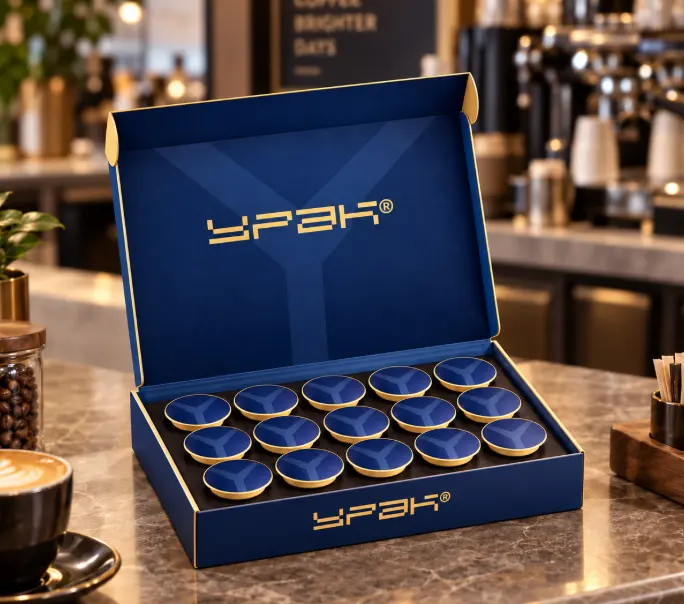
Emballage de boîte de capsule de café: Cartons de détail emballés en papier.
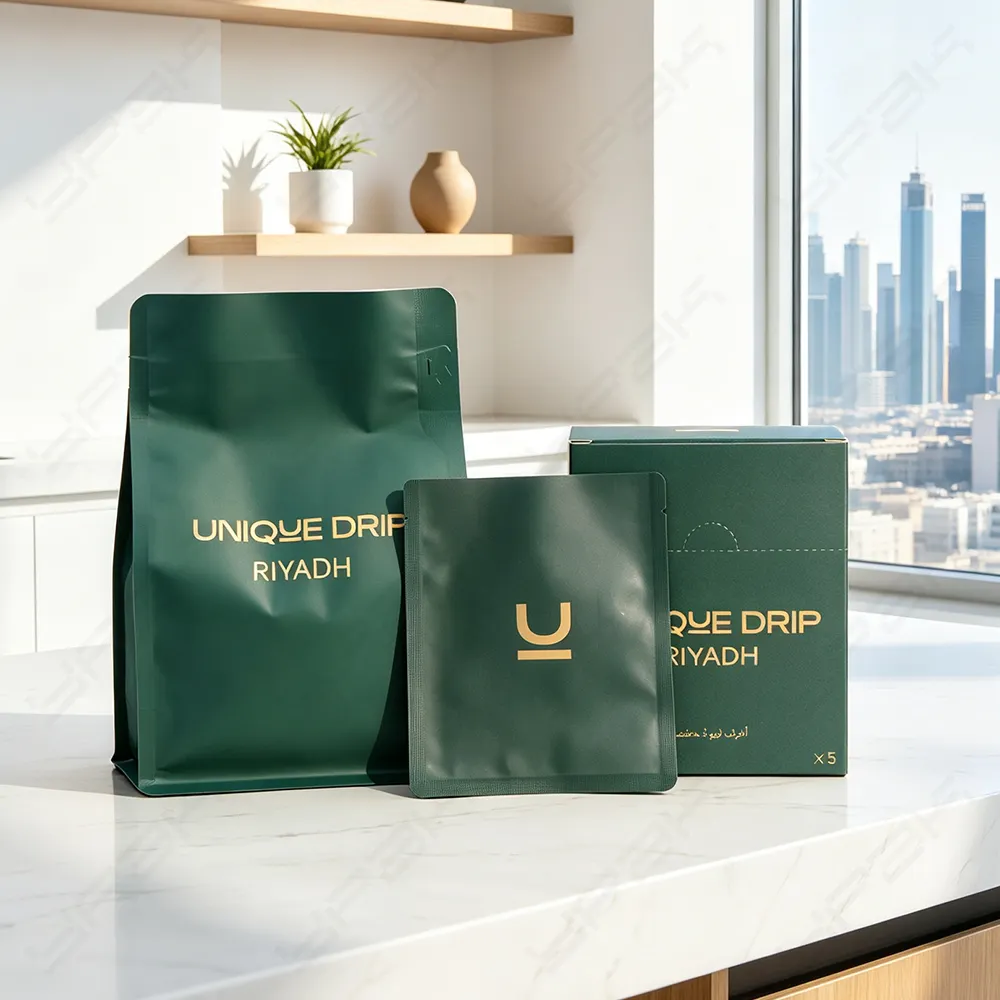
10 Boîte à café emballée: Mesures, Inserts et guide de remplissage.